 The
Brainfinger Access Solution represents a next step in the evolution of the human-computer
input interface. The system is a Brain-Body actuated control technology that combines
eye-movement, facial muscle, and brain wave bio-potentials detected at the forehead
to generate computer controls that can be used for a variety of tasks and recreations.
The
Brainfinger Access Solution represents a next step in the evolution of the human-computer
input interface. The system is a Brain-Body actuated control technology that combines
eye-movement, facial muscle, and brain wave bio-potentials detected at the forehead
to generate computer controls that can be used for a variety of tasks and recreations.
The forehead is a convenient, noninvasive measuring site rich in a variety of bio-potentials. Signals detected by sensors in a headband are sent to an interface box which contains a bio-amplifier and signal processor. The interface box connects to the PC computer’s USB port. The forehead signal is amplified, digitized and translated by a patented decoding algorithm into multiple command signals, creating an efficient, intuitive and easily learned hands-free control interface. Three kinds of signals are derived from the forehead signal.
Within the low frequency range the ElectroOculoGraphic or EOG signal is extracted. This signal is responsive to lateral eye movements and eye tension. This signal is referred to as Glance.
The second kind of signal extracted from the forehead signal is the ElectroEncephaloGraphic or EEG signal. The Brainfingers Software further subdivides this signal into nine smaller frequency bands. These smaller frequency bands reflect internal mental/brain activity as well as cross feed from facial muscles and eye movements. These signals are referred to as Theta1,2,3, Alpha1,2,3 and Beta1,2,3 signals.
The third kind of signal extracted is called the ElectroMyoGraphic or EMG signal. The EMG signal primarily reflects facial muscle activity. It is typically the easiest to control with the highest degree of accuracy. This signal is referred to as Muscle.
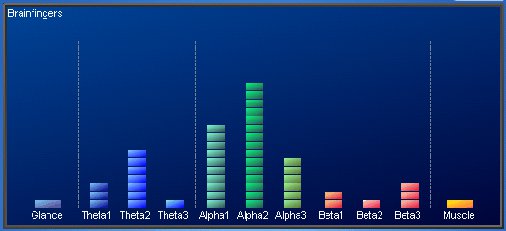
The above Brainfingers image presents a histogram of the eleven signals derived by the Brainfingers software. In this image the user first relaxed their eyes and facial muscles and then reduced their brain tension. Note the dominant frequency energy in the Alpha band.
Control of these signals is learned by first subtle tensing and relaxing of forehead, eye and jaw muscles. Once a sense of body and eye tension/relaxation control is learned, an expanded sense of control can include internal brain-based tension/relaxation awareness.
Discrete switch controls, continuous cursor movement controls and continuous joystick controls can be derived from the eleven Brainfingers individually configured or as custom weighted combinations. For individuals with limited control of facial muscles, the Brainfingers software can be formatted to use Brain-Body custom controls to activate switch closures and mouse button clicks.
The continuous and discrete control capabilities of Brainfingers can be mapped to computer events; keyboard keys, mouse keys, and cursor motion. This makes hands-free switch and mouse control possible. The user can steer the cursor, change its speed, perform left and right mouse button functions, and send keyboard characters and character string commands.
In a Brainfingers discrete switch control study conducted by the United States Air Force at Wright Patterson Air Force Base, subjects’ reaction times to visual stimuli were found to be 15% faster with a Brainfingers Muscle switch than with a manual button.
Mapping Brainfingers to computer events makes hands-free control of third-party software possible. For example, special-needs Sensory Software's Grid 2 software bundles can be controlled in switch scanning and direct selection modes with Brainfinger controls.. It is possible to control popular interactive games, word processors, spread sheets, and Computer-Aided Design programs as well.
The Brainfinger Access Solution provides an intuitive, direct, easily learned, hands-free, language-independent universal control interface. It represents a cutting-edge technological achievement in user-computer interfaces.